How to Choose a Japanese Watch Movement
There is no universally best movement. The right choice is the movement that fits the case architecture, functions, target segment, supply plan and after-sales strategy of a specific watch.
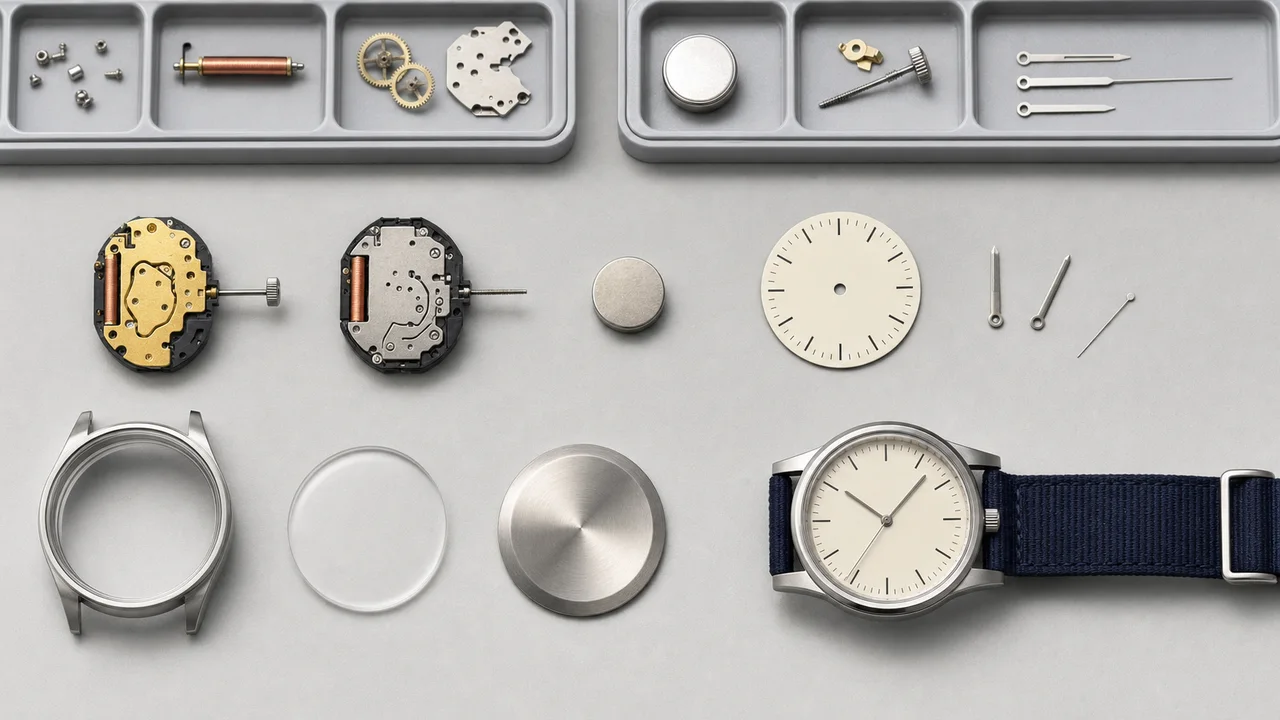
Start with the function and case architecture
Movement selection begins with the required display: time only, date, day-date, small seconds, multifunction or mechanical. Each choice affects dial openings, hand heights, crown position, case thickness and the available space for a battery or automatic rotor.
A familiar movement name cannot rescue a design that was engineered around the wrong dimensions. The product team should lock the movement family before finalising case, dial and hand drawings.
Compare specifications, not country labels
Review published dimensions, hand fitting, stem height, calendar position, expected accuracy, battery type and service information. Availability from an approved supply route matters as much as the specification because a movement that cannot be replenished creates warranty and continuity risk.
Japanese suppliers offer several movement families at different levels. Confirm the exact calibre proposed for the project rather than accepting a generic statement such as ‘Japanese movement’.
Quartz and automatic choices serve different buyers
Quartz movements generally suit buyers who value convenience, slim cases and accessible maintenance. Automatic movements create a different product story and visual experience, but they also influence thickness, wearing behaviour, accuracy expectations and after-sales communication.
The choice should follow the target customer and retail promise, not the founder's personal preference.
Plan continuity and after-sales
Ask how replacement movements, stems, batteries and technical documentation will be sourced after launch. A brand should record the approved calibre on its specification sheet and retain samples from production.
Where a supplier name may appear in marketing, confirm that the actual calibre and documentation support the claim. Never infer a branded movement from appearance alone.
Frequently asked questions
Is every Japanese movement the same quality?+
No. Movement families differ by function, construction, specification, supply route and intended price segment. Confirm the exact calibre.
Should a first watch brand use quartz or automatic?+
Choose according to the buyer, case design, retail position, warranty plan and expected user behaviour. Neither route is automatically better.
Can the movement brand be printed on the dial?+
Only use supplier names or origin claims when the exact movement and legal approval support that wording.